Learning on Country: Presence as Practice
What does it mean to practise architecture through presence – to learn from Country rather than about it? To learn on Country is to enter a relationship – with place, with people, and with the stories that connect them. It is to accept that understanding cannot precede being there, and that being there alone is not enough. Presence must be matched by listening.
Country carries its memories in different forms. Some are visible – a weathered gully, a faint track, a battered building. Others are intangible, carried in stories, languages, and practices. Even the visible traces need interpretation; without the knowledge of those who know them, we risk mistaking accident for intention, or relic for record. Learning on Country therefore involves two inseparable acts: being present within a place and listening to the people who hold its meaning.
This blog explores what happens when architecture begins from that premise. It considers four interwoven dimensions of practice:
- Presence as Practice – how being physically on site shapes understanding.
- Memory and Material History – how tangible and intangible histories inform design.
- Consultation, Collaboration, and Authorship – how listening redefines the architect’s role.
- Care as Method and Measure – how presence and listening translate into long-term stewardship.
Presence as Practice
To learn on Country beings with presence – the simple, disciplined act of showing up. But presence is not just about proximity; it is about attention. It is the first form of respect and the foundation of understanding. It means arriving without assumption, standing still long enough to notice what the place reveals, and recognising the people whose stories animate it.
Architecture often begins in the abstract: maps, models, data. Learning on Country turns that process inside-out. It insists that knowledge starts in the body – through what can be seen, heard, felt, and shared. Travel and presence are not ancillary to sustainable design; they are ethical imperatives. Experiencing heat, distance, and isolation recalibrates your understanding of performance, maintenance, and durability. Decisions about material selection, construction methodology, and lifecycle cost become grounded in lived conditions rather than theoretical performance data. In this sense, the journey to site is part of the project’s environmental accounting – a form of accountability that begins with the body. Each visit embeds accountability: once one has walked through 45-degree heat, shade design becomes an act of empathy as much as efficiency.
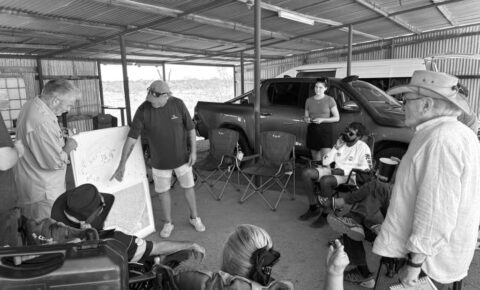
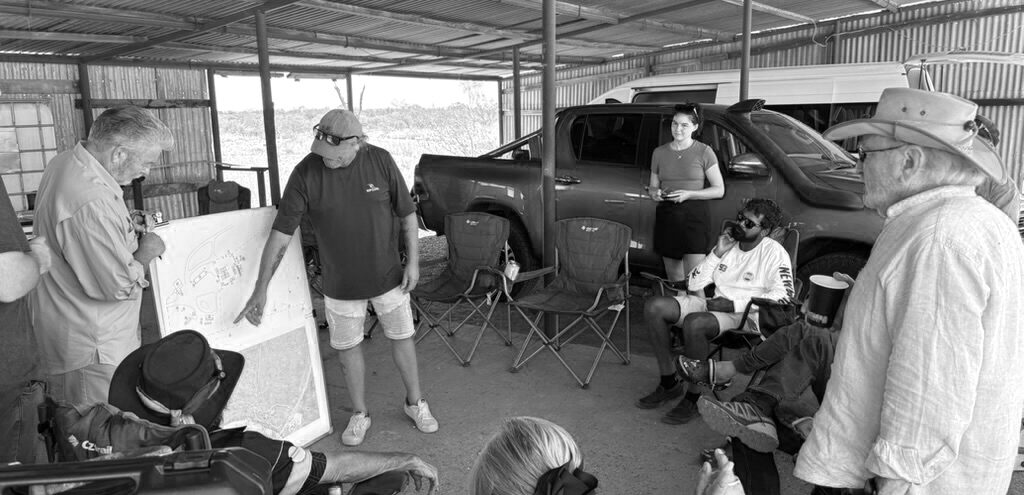
Presence creates the conditions for listening. Being there allows words, gestures, and silences to anchor to something real. On our first visit to Nanutarra, we were welcomed to Country and introduced to the site through story. Standing beside the river and walking the grounds with community members, we heard memories unfold in real time: where families once camped, the trees that hold spiritual significance, the mountains they revere, the river where they washed and played as children. They spoke of plants and animals, of storms weathered, and of hopes to regenerate the place for the next generations. These stories located meaning within the landscape itself. Later visits built upon that knowledge, allowing us to pace out new structures in relation to those remembered spaces – aligning them with existing buildings, places of significance, and long view corridors that now carry both geography and story.
To practise through presence, then, is to accept that understanding is provisional, relational, and earned. You cannot know a site without inhabiting it; you cannot hear what it has to say without listening to those who belong to it. Together, these acts turn architecture into a form of witnessing – a way of learning that begins not with design, but with respect.
Memory and Material History
Every place holds memory, but not all memory is visible. Country remembers in many ways – through soil and stone, through story and song, through the traces of what has been made and what has endured. To learn on Country is to recognise that these layers of memory coexist, and that meaning emerges only when the tangible and the intangible are understood together.
Some memories are easy to see: a hand-built wall, a worn track, the remnants of a foundation. Others live in language, in gesture, in the way people move through the landscape. Yet even the physical traces require interpretation. A ruin may tell of ingenuity or of displacement; a clearing may represent safety or loss. Without listening to those who know the stories, we risk misreading the evidence the land provides.
At Nanutarra, this interplay between tangible and intangible memory guided the restoration of the Homestead Precinct – a cluster of nineteenth-century structures whose brick, timber, and corrugated iron record generations of both European and Aboriginal occupation. Repairing these buildings is not simply a matter of conservation; it is an act of continuity, acknowledging the hardship of their making and the histories that shaped the place while ensuring their stories remain present for those returning to Country.
Flooding has left its own archive at Nanutarra. Mudbrick walls bear the marks of rising water, each line a reminder of the river’s reach. Across the site, deep crevices cut through the soil – visible evidence of how immense volumes of water move through a landscape that is now too dry to absorb them. In a place defined by heat and scarcity, those scars inspire both reverence and urgency. They reveal the power of nature, but also the consequences of pastoral degradation: eroded soils, lost vegetation, and a water cycle that can no longer hold what it receives. Setting new buildings above the flood datum translates that memory into resilience, while the broader design works to slow and capture runoff – to keep water in the ground, reduce erosion, and help the landscape recover its capacity to sustain life.
Architecture’s task is not to catalogue these traces, but to work out how to live among them. Sometimes that means protecting them from change; other times it means revealing what has been overlooked or allowing new life to grow around what remains. It demands sensitivity to both the material and the remembered – an awareness that every design decision adds another layer to a place’s history.
To design with memory is therefore to design with accountability. The materials we choose, the forms we restore or reimagine, and the silences we preserve all shape how future generations will understand this moment in a much longer story. Learning on Country transforms heritage from an exercise in preservation into a practice of participation – a living conversation between past and present, people and place.
Consultation, Collaboration, and Authorship
Listening is the bridge between knowing a place and understanding it. Once you have stood on Country long enough to sense its rhythms, the next step is to listen to those who live within them. Consultation, in this sense, is not a requirement to be fulfilled but a conversation through which meaning becomes legible. It joins the physical knowledge of being there with the cultural knowledge of those who belong.
The Guiding Principles that underpin the Nanutarra masterplan were not written in isolation. They emerged through long conversations with PKKP – discussions about what it means to care for Country, to pass knowledge between generations, and to design for both culture and climate. These principles now act as a compass rather than a checklist, shaping every decision from orientation to material selection, reminding all involved that the project’s first client is the Country itself.
When consultation happens on site, words take on spatial form. Stories point toward particular trees, water bodies, or lines of sight; gestures map paths across the ground; silences mark what should not be touched. This way of listening anchors narrative to terrain, transforming intangible knowledge into something architects can perceive without claiming as their own.
The Meeting Pavilion at Nanutarra emerged from this process. Its orientation follows the line of the Ashburton River and the sightlines to Mount Murray and Mount Alexander – directions identified by community members as significant. It is the place where PKKP people gather for meetings, ceremony, and storytelling. The building’s open form honours that purpose: enclosed enough for shelter, yet porous enough to remain part of the landscape it faces.
Collaboration grows from this reciprocity. It is not about consensus or convenience but about shared responsibility. To collaborate on Country is to accept that design outcomes will be shaped by multiple authors – Elders, community members, consultants, and the land itself. The architect’s role shifts from creator to custodian of process: to translate, not to interpret; to make space for other voices rather than to speak over them.
The Community Gathering Precinct reclaims the ground where station workers and families once camped – a place of both hardship and belonging. In conversations held on site, community members described how gatherings unfolded there: cooking under makeshift shelters, resting beneath specific trees, walking to the river to wash. The new layout restores those patterns of use, placing the kitchen, amenities, and meeting pavilion in ways that echo lived memory. Its shaded verandahs and open clearings allow the place to be used as it always has been – for events, for everyday life, and for simply being together.
This redefinition of authorship does more than diversify input – it transforms intent. Projects conceived through genuine consultation tend to be quieter, more responsive, more generous in their outcomes. They arise from trust built in the field, from conversations held under trees or beside old structures, where everyone can see and feel what is being discussed. Such collaboration teaches humility. It reminds us that the privilege of designing on Country carries an obligation to respect the knowledge that makes it intelligible. When presence and listening work together, authorship becomes shared stewardship – a form of practice grounded not in ownership, but in care.
Care as Method and Measure
The longer we practise, the clearer it becomes that every act of design is also an act of care. On Country, care means acknowledging the custodianship that has sustained these landscapes for tens of thousands of years. It means recognising that our work is temporary in the long arc of a place’s story. Care also means designing for longevity – for buildings that weather well, for systems that conserve resources, and for places that will still feel relevant in a century’s time. At its core, it’s the same lesson Country offers: take only what you need and leave something worthwhile behind.
Learning on Country reveals care as both method and measure. As a method, it guides how we work – with patience, restraint, and attentiveness. As a measure, it defines what success looks like – not novelty or visibility, but endurance, relevance, and reciprocity.
At Nanutarra, this principle is expressed in the philosophy described as a light hand and a long view. Roads follow natural contours; existing tracks are reused; structures sit lightly on the land. The aim is not to impose permanence, but to create conditions where landscape and architecture can coexist in balance. Care also informs the project’s infrastructure. Power is generated through solar arrays and stored on site; water is harvested, filtered, and reused. These off-grid networks make the site self-reliant and resilient, embodying a belief that sustainability is a form of respect.
Beyond the technical, care manifests as livelihood. The Ranger Hub and its adjoining nursery enable land management, seed propagation, and ecological regeneration – tangible expressions of care as stewardship. The Community Accommodation Precinct extends the same ethic of care to daily life. Clusters of lightweight, raised modules sit gently above the ground, allowing shade, air, water, and small animals to move freely beneath them. These structures balance durability with sensitivity – offering privacy, comfort, and dignity while protecting the ecology they are embedded within.
In this way, care extends beyond material durability to cultural and ecological continuity. It is felt in projects that can be maintained locally, in systems that give more than they consume, in landscapes that regenerate rather than erode. To design with care is to recognise that architecture is part of an ecosystem – social, cultural, and environmental – that far exceeds the lifespan of any single work.
Ultimately, care is what allows learning on Country to become a lifelong practice rather than a professional gesture. It invites us to design as participants, not observers; to approach each site as a living teacher; and to measure success by what remains strong long after we have stepped away.
An Ongoing Practice
Learning on Country is not a single event but an ongoing practice. It requires architects to decentre themselves, to acknowledge what is already known, and to participate in a dialogue that extends beyond professional boundaries. Each moment spent on Country deepens our understanding of place and the responsibility that comes with designing within it. Presence cultivates understanding; memory provides context; listening generates trust. Together, they form an architecture that is responsive rather than declarative, grounded rather than imposed. For us, this way of working is as much about our relationship to Country as it is about architecture. It’s about returning, listening again, and recognising that Country itself is our most enduring client.